
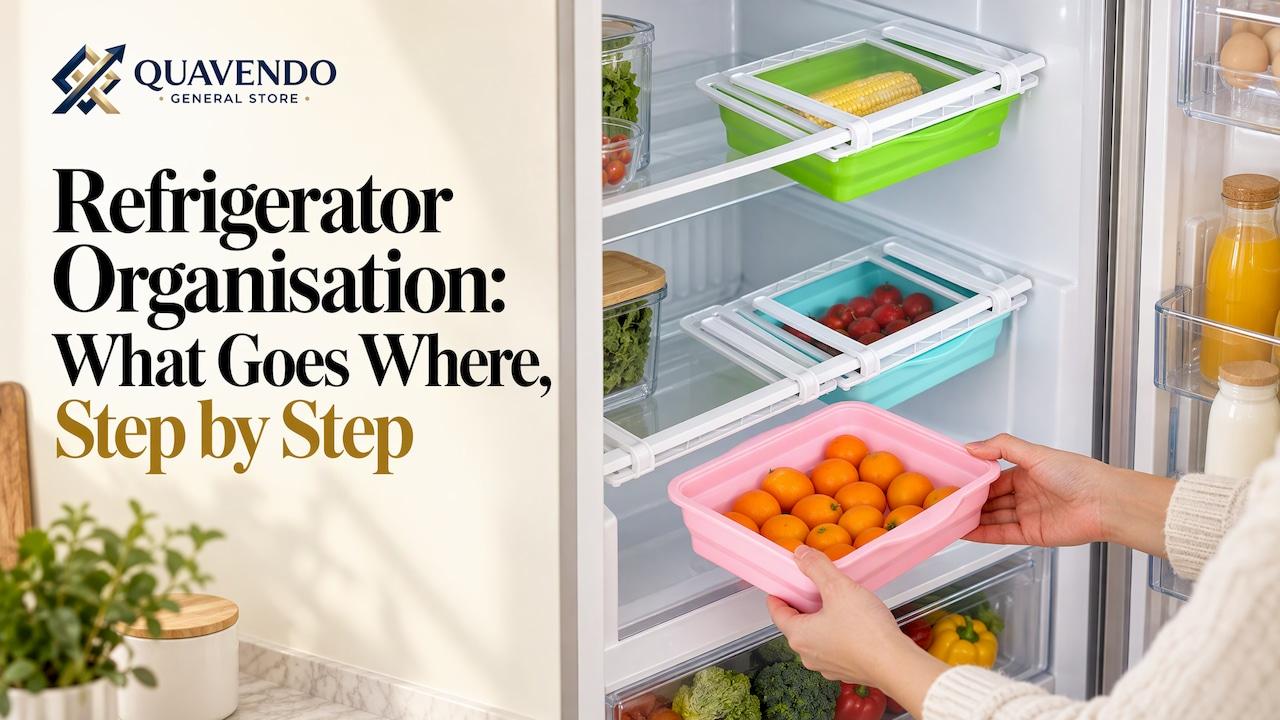
A well-organised fridge comes down to three decisions: put each food in the zone that suits its temperature and safety needs, keep everything visible in clear, labelled containers, and rotate older items to the front. Do those three things and you buy fewer duplicates, throw away less and find dinner ingredients in seconds. Clear, stackable boxes make all three easier, which is why our fridge organiser with foldable transparent storage boxes is built around them.
This guide walks through the full reset, the shelf-by-shelf map, drawers and doors, space-saving ideas for family fridges, and a short weekly routine to keep it all in order.
TL;DR
- Store food by temperature zone: ready-to-eat items on upper shelves, raw meat, poultry and fish on the bottom shelf in a container, produce in the drawers, and only condiments and drinks in the door.
- Keep milk and eggs out of the door, where the temperature swings most. Eggs stay in their carton on an inner shelf.
- Clear, labelled boxes and a dedicated "eat this first" spot make it obvious what needs using, which is the simplest way to cut food waste.
- Do a full clean-out every few months, then a five-minute tidy when the shopping comes in: oldest to the front, newest to the back.
Table of Contents
- Start with a full reset
- The shelf-by-shelf map: what goes where
- Drawers: sort by humidity, not by habit
- Make everything visible
- Why it is worth the effort
- Ideas for getting more out of a small or crowded fridge
- A simple routine to keep it organised
- Safe-storage reminders worth keeping
- Build the system with Quavendo
- FAQ
- Sources
Start with a full reset
You cannot organise a fridge that is full of half-used jars and unlabelled leftovers. The best starting point is a clear-out. Iowa State University Extension's guide to organising your refrigerator lays out a simple sequence: unplug the fridge and empty it, throw away anything spoiled (keeping perishables in a cool bag or cooler meanwhile), wash the shelves and drawers in hot soapy water, and only then reload.
In practice, here is how to do it in about 45 minutes:
- Take everything out and group it on the worktop: dairy, meat, condiments, leftovers, produce, drinks.
- Bin what is past it. Anything with an unknown date, a mouldy lid or a smell goes. Check condiments too; they hide at the back of the door for months.
- Wash removable parts. Shelves, drawers and door bins come out and go in hot soapy water. Wipe the inside walls and the door seal.
- Check the temperature. Illinois Extension's refrigerator storage guidance says to keep the fridge below 40°F (about 4°C) and not to overcrowd it, so air can circulate. A separate appliance thermometer is the reliable way to check, as the USDA's Kitchen Companion handbook recommends.
- Reload by zone, using the map below.
The temperature figure matters because of what happens above it. USDA food safety guidance describes a "danger zone" between 40°F and 140°F (4.4°C to 60°C), where bacteria multiply quickly, and says perishable food should be refrigerated within two hours, or one hour if the room is above 32.2°C. That is worth remembering when the weekly shop sits on the counter while you put it away.
The same handbook sets the freezer at 0°F (-17.8°C) or below. If your fridge dial has no temperature markings, a cheap thermometer on the middle shelf removes the guesswork.
The shelf-by-shelf map: what goes where
A fridge is not one uniform temperature. The back of the bottom shelf is typically the coldest part, and the door is the warmest. Consumer Reports found in climate-controlled tests that door temperatures run a couple of degrees above the main compartment, which is too warm for milk and eggs despite the bins and egg holders many doors include.
Here is the layout most food-safety bodies agree on:
| Zone | What belongs there | Why |
|---|---|---|
| Top shelf | Leftovers, ready-to-eat foods, jam, snacks, yoghurt, drinks | Steady, moderate temperature, and nothing above it to drip onto it |
| Middle shelf | Eggs in their carton, cheese, cooked foods | Eggs stay cold and shielded from smells |
| Bottom shelf | Raw meat, poultry and fish on a plate or in a sealed container; milk toward the back | Coldest area, and any juices cannot contaminate food below |
| Crisper drawers | Fruit and vegetables, split by humidity | Sealed drawers prolong produce life |
| Door | Condiments, sauces, juice, oils, water | These tolerate the warmer, fluctuating temperature |
Raw meat belongs at the bottom
The rule is simple: raw meat, poultry and seafood go on the bottom shelf, in a container or on a plate, so that juices cannot drip onto other food. The US government's FoodSafety.gov says the same: keep these foods separate and use containers or sealed bags to stop drips. Hong Kong's Centre for Food Safety adds that raw food should always be stored below cooked and ready-to-eat food, in covered or sealed containers, in its June 2025 Food Safety Bulletin.
If your fridge has a dedicated meat or fish drawer, use it. Consumer NZ's guide to organising your fridge explains that this chiller drawer runs at around -1°C, which keeps meat as cold as possible without freezing it, while also containing spills and odours.
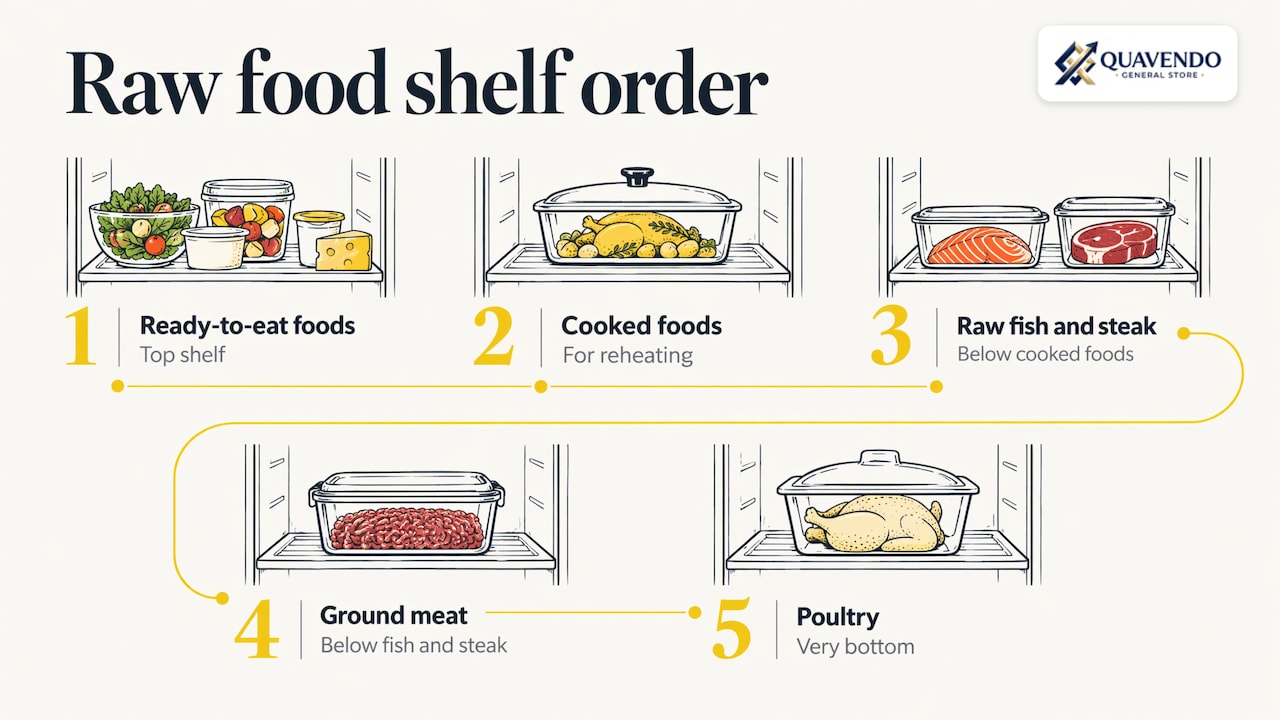
Illinois Extension goes further and suggests ordering raw foods by what they need to be cooked to: ready-to-eat foods on the top shelf, then cooked foods for reheating, raw fish and steak, ground meat, and finally poultry at the very bottom. It is a tidy system if you cook a lot of raw meat; if you do not, the simple rule of "all raw meat at the bottom, contained" covers it.
Milk and eggs: inner shelves, never the door
It is tempting to use the door for milk, because the door usually has a bottle-shaped slot. Resist it. The USDA's food waste advice says to avoid keeping perishables like milk in the door because the temperature fluctuates more there than inside the main compartment.
The Academy of Nutrition and Dietetics recommends storing milk where it is coldest, at the back of the bottom shelf, and keeping eggs in their original carton in the centre of the fridge. The carton matters: Consumer NZ notes that eggshells are porous, so out of the carton they absorb smells and lose moisture. The USDA's handbook also directs that eggs go on a shelf in the main compartment, never in the door.
Butter is a surprise for many people: the dietitians advise keeping it inside the fridge, because the door butter compartment is not cold enough.
What the door is actually for
The door is the right home for ketchup, mustard, jars of pickles, cooking oils, bottled water and fizzy drinks, and juice. Consumer Reports lists exactly these as door-suitable. The upside is visibility: Iowa State points out that condiments in the door are easy to see, which also helps you avoid buying a fourth jar of mayonnaise.
Drawers: sort by humidity, not by habit
Most fridges have two crisper drawers, often with a slider marked for humidity. Use them deliberately.
N.C. Cooperative Extension's refrigerator safety and organisation guide recommends one drawer on low humidity for fast-ripening produce such as apples, pears and avocados, and one on high humidity for things that wilt, such as leafy greens and fresh herbs.
Consumer Reports offers a more detailed split:
- Low humidity: apples, grapes, mushrooms, peppers, ripe melon, ripe stone fruit, ripe avocados and summer squash.
- High humidity: broccoli, carrots, cauliflower, spring onions and leafy greens.
It also advises against mixing fruit and vegetables in the same drawer. Some fruit, pears for example, gives off ethylene gas, which speeds up spoilage in sensitive vegetables such as broccoli.
Because every fridge behaves slightly differently, Consumer NZ's expert says humidity settings take some trial and error. If lettuce keeps wilting, move the slider and watch for a week.
One more detail: not everything belongs in the fridge. Hong Kong's food safety bulletin notes that bananas can suffer chilling injury in the cold, so keep them in the fruit bowl.
Make everything visible
A perfectly zoned fridge still wastes food if you cannot see what is in it. Wirecutter's kitchen editors frame food waste as a visibility problem: you do not know what is in your fridge, and then it goes off. Their conversation on wasting less food points to labelling and first-in, first-out rotation, borrowed from professional kitchens, as the core fixes.
Clear containers and labels
The USDA recommends clear containers so you can see what you have and avoid buying duplicates. The South Carolina Department of Environmental Services food waste guide adds that containers should be covered and labelled with a purchase or use-by date.
A roll of masking tape and a marker is all the labelling system you need. Write the date you opened or cooked the item, not the date you intend to eat it.
Transparent, foldable boxes are particularly useful here because you can group things by type, such as cheese and deli, snacks, or salad bits, and pull out an entire box to see what is at the back. They also fold flat when you do not need them, so they do not take up cupboard space. Our fridge organiser with foldable transparent storage boxes is made for exactly this job.
For dry goods stored outside the fridge, such as rice, pasta and cereal, the same principle applies. Our transparent food storage containers for grains let you see levels at a glance, so you know what to restock before you shop.
First in, first out
First in, first out, or FIFO, simply means older food goes at the front and newer food goes behind it. Wirecutter's editors describe moving the old milk forward when new groceries arrive, and doing the same with eggs. Illinois Extension also recommends FIFO to reduce waste.
The habit takes about two minutes when you unpack the shopping. Pull the old items out, put the new ones at the back, and put the old ones back in front.
An "eat this first" spot
Both the South Carolina guide and the FDA's tips to reduce food waste recommend a designated place for food that is going to go off soon. A single clear box on the top shelf, labelled "eat this first", works well. Everyone in the household learns to look there before opening anything else, which suits busy weeknights and children who graze.
Iowa State suggests a dedicated leftovers shelf too, with the oldest food at the front. N.C. Extension says leftovers can stay in the fridge for two to three days, in clear, labelled, dated containers on the top shelf. Iowa State suggests freezing anything not used within four days.
Why it is worth the effort
The numbers on household waste come from the US, but they show the scale of the issue. According to the South Carolina Department of Environmental Services' Don't Waste Food guide, households account for 40% of US food waste, American families throw away around 21% of the food they buy, and 71% of food thrown away at home could have been eaten. It estimates the cost at up to $1,800 per family per year.
Whatever your own figure, the logic holds: food that you can see gets eaten, and food you have forgotten gets binned. A tidy fridge is the cheapest form of meal planning there is.
Ideas for getting more out of a small or crowded fridge
Space is the usual complaint. These ideas come up repeatedly in the guidance and work in most kitchens.
- Do not overfill. Illinois Extension advises against overcrowding so that cold air can circulate. Packed shelves cool unevenly.
- Move drinks out. Iowa State suggests keeping bottled and canned drinks in a cupboard or pantry and chilling them with ice when needed, which frees a surprising amount of shelf.
- Decant juice into smaller containers if a large carton is eating up space.
- Use stackable boxes so you use the height of each shelf rather than just the floor of it.
- Put long-stay condiments on a turntable. Wirecutter's editors suggest a lazy Susan rather than jamming jars into the door.
- Cover or wrap everything. Iowa State recommends foil, plastic wrap, bags or airtight moisture-proof containers. Covered food also keeps smells from spreading.
A family-friendly setup
If you have children, a low, easy-to-reach box of snacks, such as yoghurt pots, cheese portions and cut fruit, saves you from constant fridge-door requests, and keeps them away from raw meat and the open door. Keep it on a middle shelf rather than the bottom, which is reserved for raw items.
For busy professionals, the useful variant is a "grab and go" box: lunch components, sandwich fillings and fruit, ready to pick up on the way out.
If the rest of the kitchen needs the same treatment, our guide to organising small kitchen countertops follows the same step-by-step logic.
A simple routine to keep it organised
Organisation fails when it depends on a big weekend effort. A light routine works better.
When the shopping comes in (five minutes):
- Refrigerate perishables promptly, within two hours.
- Rotate: old to the front, new to the back.
- Put anything opened or cooked into a labelled container.
Once a week (ten minutes, before the next shop):
- Check the "eat this first" box and plan a meal or two around it.
- Bin anything past its date.
- Wipe up any spills straight away.
Every three to six months (about 45 minutes):
- Do the full reset described at the start. The South Carolina guide recommends a deep clean every three to six months, and Illinois Extension notes that regular cleaning helps prevent the growth of Listeria monocytogenes, a bacterium that can multiply even at fridge temperatures.
The South Carolina guide also suggests setting the fridge at 37°F (about 3°C) as a sweet spot, with 40°F as the upper safe limit. Check your own appliance's manual, and use a thermometer to confirm.
Safe-storage reminders worth keeping
- Leftovers: use within two to three days, according to N.C. Extension.
- Raw mince and poultry: Illinois Extension says to keep uncooked ground meat and poultry only one to two days before cooking or freezing.
- Cracked eggs: the USDA says to break them into a covered container and use within two days. Do not freeze eggs in their shells.
- Storage times: the FDA recommends the FoodKeeper app for how long different foods keep.
- Pregnancy, older age or a weakened immune system: Listeria is of particular concern for these groups, so speak to your GP or midwife about which chilled foods to avoid.
These are US sources, and UK guidance uses Celsius and its own recommended temperature; check the Food Standards Agency's pages for UK-specific rules on date labels and storage.
Build the system with Quavendo
The most effective fridge systems are simple: clear boxes, labels, and a clear spot for everything. Our Kitchen & Home Solutions collection brings together kitchen organisers, food-storage accessories and everyday tools chosen to reduce hassle. If you want a place to start, the fridge organiser with foldable transparent storage boxes gives you the visible, grouped storage this guide is built on.
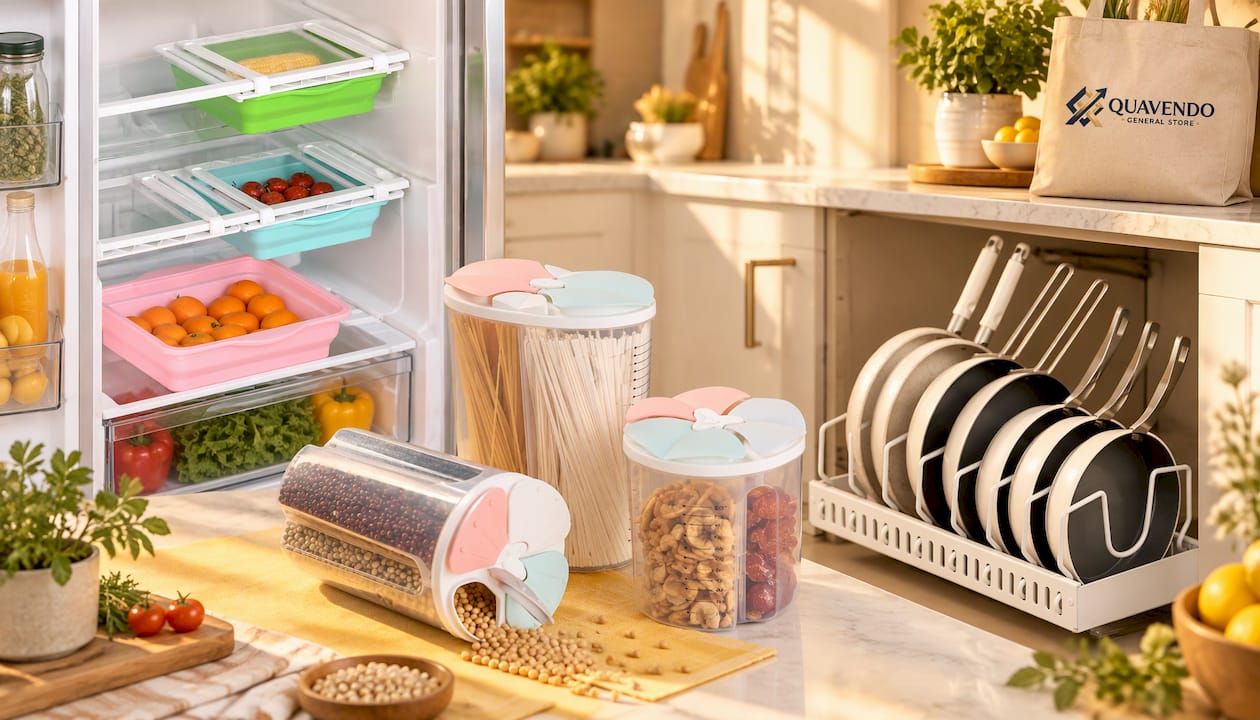
We choose products for families and busy households who want less stress and more living, and a fridge you can read at a glance is one of the quickest wins in the kitchen.
FAQ
What is the proper way to organise a refrigerator?
Work by temperature zone. Put ready-to-eat food and leftovers on the upper shelves, eggs and dairy on inner shelves, raw meat, poultry and fish in a container on the bottom shelf, produce in the drawers, and only condiments and drinks in the door. Label everything and rotate older items to the front.
Where should milk be stored in the fridge?
On the bottom shelf toward the back, which is the coldest part, and not in the door. The door temperature fluctuates more, which is why the USDA and Consumer Reports both advise against keeping milk and eggs there.
What goes in the fridge door?
Condiments, sauces, pickles, cooking oils, juice, water and fizzy drinks. These cope with the warmer and more variable temperature at the door. Butter is better kept on an inner shelf.
How often should I clean out my fridge?
A full clean-out every three to six months is recommended, with a quick wipe of spills as they happen and a weekly check for anything past its date. Regular cleaning helps prevent the growth of Listeria.
How do I keep my fridge organised week to week?
Tie it to the shopping. When groceries arrive, rotate old items to the front, label anything opened or cooked, and keep a clear "eat this first" box. Ten minutes before the next shop is enough to keep things in order.
Sources
- Organize Your Refrigerator, Iowa State University Extension
- Refrigerator Storage, Illinois Extension
- Kitchen Companion: Your Safe Food Handbook, USDA FSIS
- 5 Steps to an Organized Refrigerator, Consumer Reports
- Food Safety Tips for the Holidays, FoodSafety.gov
- Food Safety Bulletin, Centre for Food Safety Hong Kong
- How to organise your fridge and what food should go where, Consumer NZ
- How to Reduce Food Waste at Home, USDA
- Does Your Refrigerator Need a Makeover?, Academy of Nutrition and Dietetics
- Refrigerator Safety and Organization, N.C. Cooperative Extension
- The Wirecutter Show: Creative Ways to Waste Less Food
- A Guide for Reducing Food Waste at Home, South Carolina DES
- Don't Waste Food SC Guide
- Tips to Reduce Food Waste, FDA